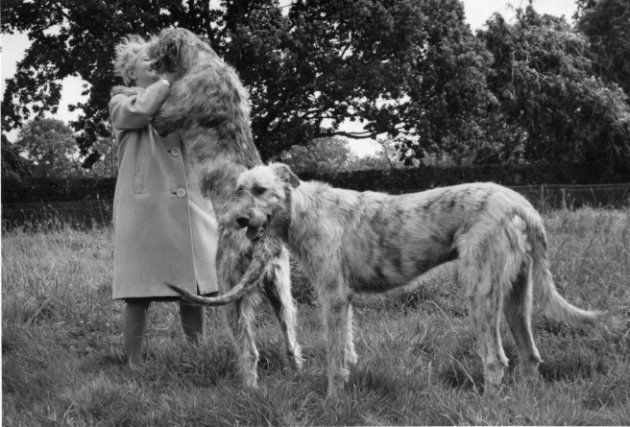
Iain Gordon talks to Miss Margaret Harrison and discovers that a combination of dogs and music has given the versatile Harrison family a continual source of enjoyment.
The photographs were not in the original article but have been added for the website.
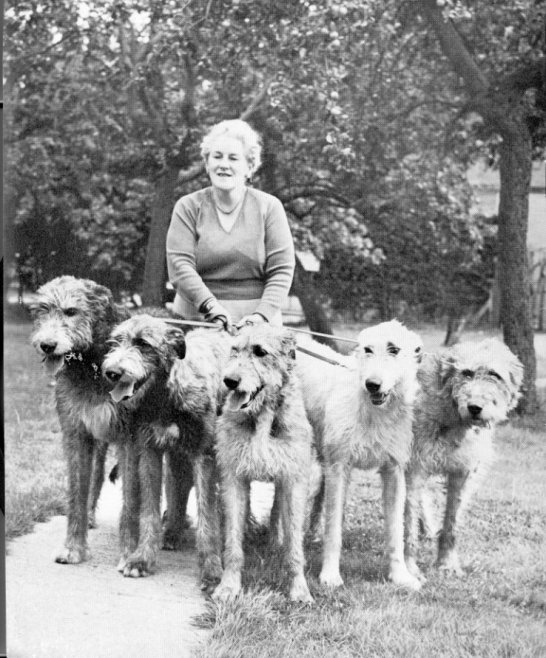
The world of dogs has never lacked colourful personalities, individuals who have travelled the world over, led interesting lives and met and known famous and interesting people. However, none have been so close to the heart of artistic and, especially, musical life in the twentieth century as the greatly talented Harrison family. There was May, a violinist, Beatrice, the famous cellist, Monica, a singer, and Margaret, the youngest and remaining sister, also a violinist. Margaret has always had a particular passion for animals of every sort and founded the famous Sanctuary of Irish Wolfhounds, Pomeranians, Pekingese and Scottish Terriers.
| |
| Margaret getting a special greeting |
The Irish Wolfhounds are her special favourite and several Sanctuary bred hounds have become mascots for the Irish Guards. On the wall of the music room, which is devoted to dogs, there is a photograph of Miss Harrison handing over Connor, the present incumbent, to the regiment's Colonel-in-Chief, HM Queen Elizabeth, the Queen Mother. Cormac, his predecessor, is buried in the grounds of her home, Hollesley Farm, with a stone to mark his grave. A prized possession is a beautifully made model of a guardsman in full regalia leading a Wolfhound wearing his regimental coat - both uniforms (which are made of fabric) are correct in every detail. There are, at present, seven Irish Wolfhounds (besides a vociferous group of Poms) in the kennels, three dogs and four bitches. Miss Harrison says, "I have enquiries for puppies almost every day because ours are so sweet-tempered - they've always had wonderful temperaments."
If one wall is dedicated to dogs, the rest of the room celebrates music. On entering, the eye is immediately drawn to a striking painting of Beatrice Harrison playing the cello, to photographs of Elgar and Delius on an occasional table. On the piano sits a drawing of Delius and a photograph of the Russian composer Glazunov, inscribed to May Harrison in remembrance of the concert she gave in St. Petersburg in 1912.
The Harrison girls were musicians of distinction and all had brilliant careers except Monica, who was too delicate to become professional. They numbered among their friends, apart from those already mentioned, Sir Henry Wood, Sir Thomas Beecham, Paderewski, Fauré, Roger Quilter and Percy Grainger, as well as George Bernard Shaw and Dame Nellie Melba, the great Australian prima donna.
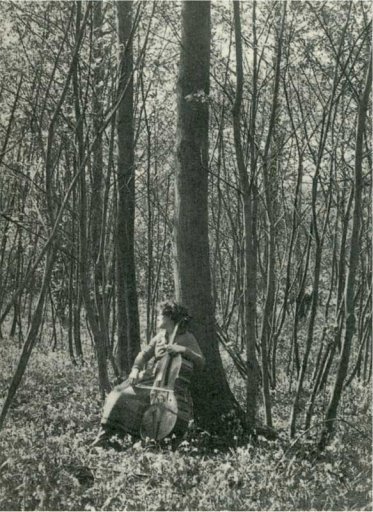
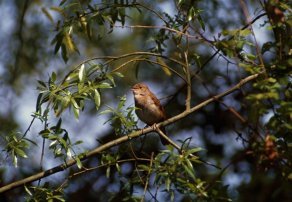
Margaret was accepted as a pupil at the Royal College of Music at the tender age of five ('I was the youngest student ever - now I'm the oldest'), and she became much in demand as a solo performer in her own right, but she often played with Beatrice and accompanied her on her world tours. For Beatrice came to be recognised as one of the greatest cellists of the day and was renowned for her performances in concert halls internationally, although perhaps her most splendid achievements were the broadcasts she made playing to the nightingales as they sang in the garden at Foyle Riding, their home in Surrey.
 |
 |
| To listen to the BBC broadcast made on 19th May 1924 see - http://www.bbc.co.uk/programmes/p01z12h7 - on The History of the BBC | |
These introduced her to a vast public who would never have thought of listening to the cello in a concert hall, and are still remembered and loved all over the world as a haunting and perfect evocation of summer evenings in an English country garden. How did these fantastic recordings come to be made?
"My sister loved going out in the garden or the edge of the wood and she liked to work and practice there in the evening. One night she heard a lovely bird singing and she was so excited. Next morning she spoke to one of our two dear old gardeners and said, 'Hockham, I heard a wonderful bird last night', and he said, 'The nightingales have come back. They've been gone a long time from here but they've heard your playing and come back.' Every night Beatrice used to go out and play, if it wasn't raining, of course. She was playing the Elgar concerto with Elgar at the Central Hall in London and, talking to the announcer, said, 'I've got such a wonderful nightingale in the wood, I do wish you could broadcast it so other people can hear it, even abroad.' He replied, 'Well, I'll have a word with Captain Eckersley, the head engineer, and see what he thinks.' Two or three days later Captain Eckersley rang and said, 'I think it would be possible; I'll come down and see you.' Beatrice showed him where she played to the nightingale and he said, 'We'll try it.' So they brought down their paraphernalia, tested it and found it feasible, and one night in May they did it, and again the next week and the following year with two microphones. It was heard in Italy, Paris and London, even as far away as New Zealand, and we got thousands and thousands of enthusiastic letters from people all over the world.
"What I've done is to make a trust of all my things, including these letters, over 900 pieces of music and all our photographs and they will all be on view for people to see. We've got 45 letters Elgar wrote to Beatrice about his work and how she should play it and we've got many, many from Delius too. They're all very valuable so they're locked up in a safe at the moment."
I asked where she planned on having these valuable things displayed. "I don't know. I've tried one or two places but they have no space. That nice man, Bennett I think his name is, has a piano museum. He's got 50 pianos and I asked him if he had any room. 'Dear Miss Harrison,' he said, 'I couldn't get another sheet of music in.' - it's very difficult."
The story of Beatrice Harrison was published in 1985 from the journals. It has a foreword by Julian Lloyd Webber and is absolutely fascinating and should be read by everyone with an interest in music. I will treasure the signed copy Miss Harrison gave me of this wonderful book called The Cello and the Nightingales.
Not all their great friends were professionals, however; some were gifted amateur musicians. "Our very greatest friend was Princess Victoria, daughter of Queen Alexandra and George V's sister, though we knew her long before, when she was at Iver. We used to go down there almost every Sunday and play with her. She played the piano and we've got records of her playing with us; they're all on tape now. She was our dearest friend till she died and we have letters galore from her; she liked to know everything we were doing, she loved the family."
I asked Miss Harrison if they had also known Ethel Smyth, the famous and slightly eccentric composer. I felt sure they must have done. "Oh, yes. Dear Ethel. She owned Bobtails and we also had a Bobtail, so we were very friendly, having both music and dogs in common. A similar situation arose with Sir Edward Elgar. He had three dogs: Marco, a spaniel; Meg, a Scottie; and Mina, a Cairn, and we gave him the Scottie, of course. He had two from us; the first one unfortunately died, but then he had Meg and he adored those dogs. When we were playing at the great music festivals at Hereford, Gloucester, Worcester and Three Choirs I was driving, so we used to go down by car. Sir Edward loved driving so I used to go to him in the morning at about 9 o'clock and we'd go off with the three dogs sitting on the back seat. We used to go for miles and miles and he loved it.
"He had a great affinity with Marco, the spaniel, because, when Elgar was conducting and broadcasting, Marco used to sit on a chair near the wireless set by the housekeeper and would listen. When Sir Edward had finished and the clapping had nearly stopped he'd go up to the microphone and say 'Goodnight Marco.' That's absolutely true for I've seen it. He did love his dogs, he really did. Beatrice always played at one of the Festivals and Bernard Shaw used to often be there, so we knew him quite well and had some lovely cards from him, as well as letters from all the great composers. It's so nice to go back. People often say to me: 'Isn't it sad looking back?' and I say 'No, it's a great joy' because you knew the personalities; you hadn't just heard of them, you knew them well and that's a great pleasure."
Another of these personalities was Sir Henry Wood, and Miss Harrison played at the Proms many times. "I made my orchestral debut there. We knew dear Sir Henry very well and he was very kind to young people. He always gave the younger generation the chance to perform at the Proms, so of course they adored him; he arranged for me to play violin concertos there."
Miss Harrsion proudly showed me her violin, which was made in the early nineteenth century in Scotland by Matthew Hardy. She told me that their very first teacher had, in fact, been the violinist in the band of the Royal Engineers, their father's regiment. At the Royal College their teachers were Senor Arbos, a Spaniard, and Professor Rivarde, who was French. When they had finished their studies in London, Beatrice went to study with the great cellist Hugo Becker in Berlin, and May and Margaret travelled to St. Petersburg to work with the eminent Professor Leopold Auer. Naturally Margaret took her pets with her.
PAST AND PRESENT
"Mother knew I'd be unhappy without an animal, so I took two tree frogs and in the evening they used to hop about the kitchen and catch beetles. Later, when May and Beatrice went back to Russia to play, they went to the ballet school in St. Petersburg and the ballet master wanted Beatrice to train as a dancer. He said: 'You're born for it; you've got the looks, you've got everything.' but she said, 'No, it's the cello for me, I've got to make people love the cello.' and I think she did. There weren't many women cellists before her and I think she's still the greatest woman cellist, even more so than Jaqueline du Pré, who sadly died so young. Beatrice watched her on television and said: 'What a talented girl she is.' She was right, although I was always a bit worried that she made so many grimaces and things like tossing her hair about. We were not allowed to do that; we had to practice in front of a mirror to make sure we were not making faces."
I asked her what she thought of modern music and of the instrumentalists who performed it and the composers who wrote it. Did she find any of it interesting? "I find a lot of it interesting. But, you see, the young are little bit inclined (I hope I never was) to think they know best. If something is old fashioned, they know better, and you have to explain to them how important the older lot of great musicians are; they have to study them. I'm very pleased that modern recordings of the wonderful violinists of the past such as Joachim, Ysaye and Sarasate are now available. Kreisler, too, was a great friend of ours. His first record, made early in 1900, has been re-recorded and it's wonderful. You can hear them, listen to what they do, and that's what I tell these young violinists and cellists."
Miss Harrison certainly does not live in the past, as far as music or anything else is concerned, and I noticed a tape by popular contemporary French pianist, Richard Clayderman. Did she also perhaps like pop music?
"Oh, of course, very much, and I adore - well, I won't say 'adore', that's too excessive - Gershwin and all these American composers like Jerome Kern. I like them very much; it's so easy, their music, and I'm thankful they're bringing back some of their shows. They were so clever at orchestrating, much more than they are now, but I won't mention any present ones that I don't like." She roared with laughter. "When we lived in London we were very fond of going to musical comedies, even though one loved what they call the 'classics', which I think is dreadful, because nothing is really classic, but we loved musicals."
Of all the great composers, the family were particularly friendly with Delius, who dedicated his cello sonata to Beatrice, and began composing his cello concerto in the garden of their house, The Waffrons, near Thames Ditton.
I wondered if Miss Harrison had seen Ken Russell's TV film about the last months of the composer's life, when he was ill and blind, and a young Englishman, Eric Fenby, went to his home in France to help him write down his music.
"Yes, I did. I actually wrote to Ken Russell and said 'I can give you a few ideas'. He said 'Thank you, but it was all written six months' ago.' The picture of Mrs. Delius was entirely different - she was a dear, a motherly person, spoke in a slightly sing song voice and was Scandinavian. I can't think why Eric Fenby didn't say anything and said to him: 'Eric that wasn't the real Jelka in the film'. He replied 'No, but there was nothing I could do'.'"
| Miss Harrison went on to speak more of Delius, who used to be known to his friends as 'Fred', and gave a fascinating picture of a great English composer. |
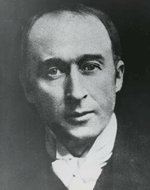 |
"He was very proud of being a Yorkshireman. There were 11 in the family, boys and girls, so he had a ready-made cricket team. One of the girls once said to me: 'Margaret, Fred used to keep us at it all the time playing cricket and we would get more and more tired - he was such a cricketer.' I knew that because, when he was living in France, he wanted to know all about the cricket in England and the results of all the matches. If he hadn't been a composer I think he'd have been an amateur cricketer, which is strange. My mother and Delius got on very well; he used to laugh helplessly; he had a great sense of humour and so had my mother. It was a wonderful period. I'm going to give a talk to the Delius Society about my sister May, as it's a hundred years since she was born and she and Eric Fenby worked a lot with Delius. We seem to have known Delius a bit differently to other people. They keep saying he complained a lot but you have to remember that latterly he was very ill and by nature he had been a very energetic man. He was a great mountain climber and he used to climb in Scandinavia.
"We had a wonderful time with Delius. People can be rather unkind about him, you know, but he was sometimes inclined to say things he didn't really mean. A lot of people go to see his grave, however, and we've put a new stone up to replace the frightful Cornish granite thing they had. It has a gold cross on a grey background; it's most beautiful and Delius would have loved it. I went there when it was erected; it's at St. Peter's Church, Limpsfield; a lovely little church. My family's buried there, too. We gave a concert there last year and played Delius and Elgar songs.
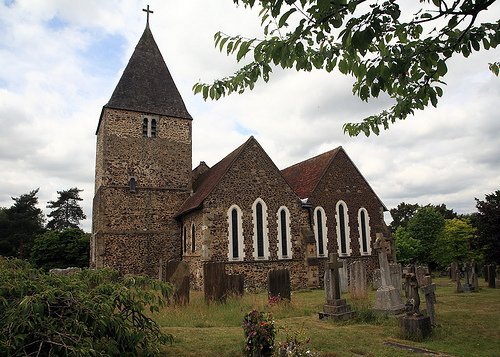 |
| St. Peter's Churchyard |
"It's been a lovely life, with all the nice people we met. My uncle, my mother's brother, was an actor, and called himself Charles Carrington. He was a great friend of Shaw, and introduced the plays of Ibsen to England. Janet Achurch, the actress who played in many Shaw and Ibsen plays, was his wife. Beatrice and my mother knew Melba very well and toured America with her. She used to keep my mother in fits of laughter; they had a wonderful time. Melba used to wear very tight corsets and on one occasion, before she went on at the Carnegie Hall, found they were too tight and said to my mother 'Oh Mrs. Harrison do undo me at the back. Unlace me.' My mother had a hat on with osprey feathers and, as she was unlacing the stays, the feathers got caught in Melba's wig. Mother was in such fits of laughter that she could do nothing and, in the end, they got so entangled that both hat and wig had to come off. Beatrice was a great success on that tour, almost more than Melba, although she was young and the supporting artist. When Princess Victoria said to Melba: 'I believe Beatrice Harrison was your young supporting artist?' Melba said: 'She should have been a co-artist'. She knew, you see."
WELL LOVED FRIENDS
Were all four sisters involved with May Atfield in the Sanctuary Kennels? "We always had dogs. I mean, I was brought up by a St. Bernard at Chatham, where I was born. My father's groom imported two St. Bernards. Of course there was no quarantine then, and they had a litter of two - a dog and a bitch - and my mother gave the dog to me. We were born on the same day. He was always with me from the time we were six weeks old and even when I went out in my pram I was holding him. I adored him. I used to ride on his back; his name was Leo. Then we had a Fox Terrier and that was the start of our dogs. When we went to London we had Scotties and when we moved to the country we began to breed them until we moved to a big house not far from here, where I started the Wolfhounds. May Atfield was my partner and my guiding spirit with the dogs and she said:'You've got lovely Wolfhounds, you should show and breed them.' She was trained by Cornish Bowden, who was a great vet at the time and a well-known judge. She introduced Pekes and Poms to the kennels and I loved them all. We used to say 'Music was our life but dogs were our great pleasure'."
 |
 |
 |
 |
 |
 |
January 3rd, 2016